

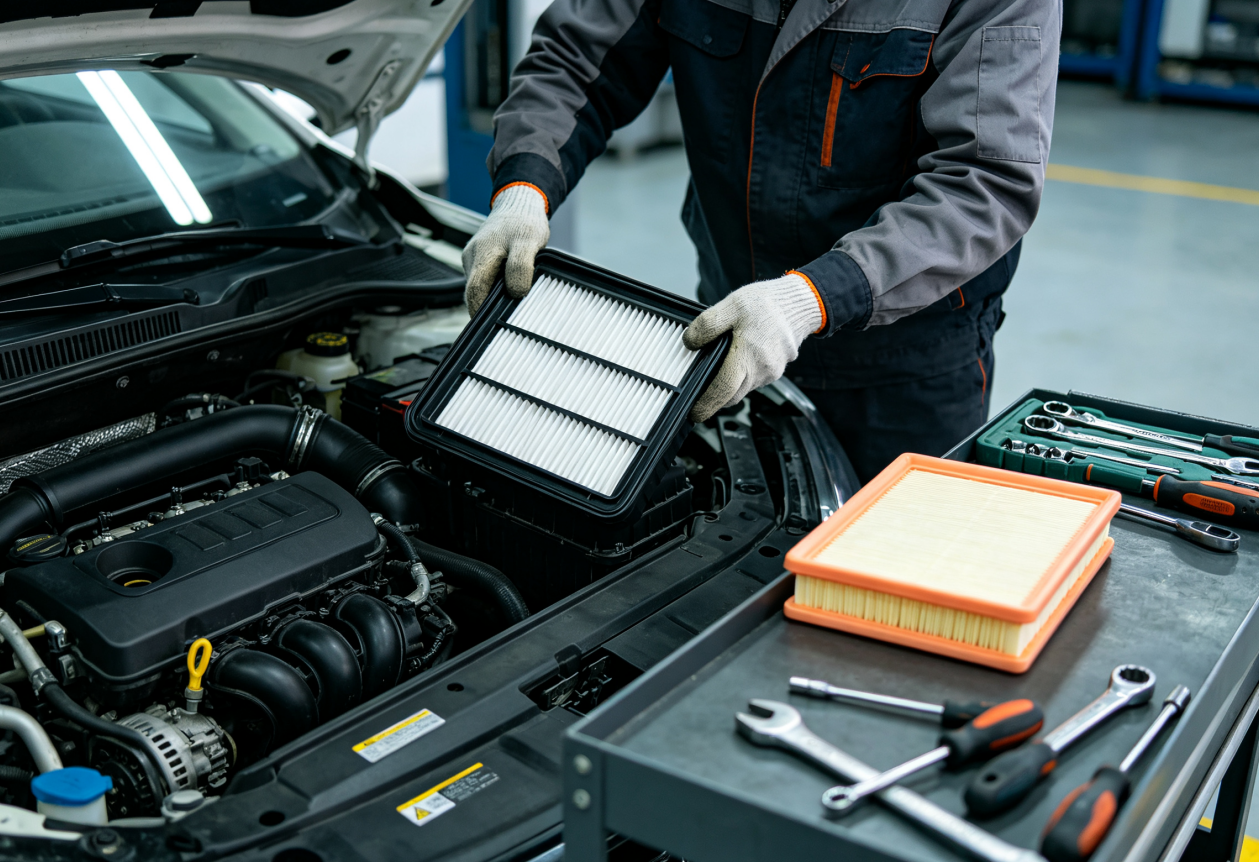
Car owners have often noticed that after a few years of use, the fuel consumption of their vehicles steadily rises to levels higher than when it was new, and acceleration on the road seems much less responsive as it used to.
While some suspect a failure in the engine, others criticize the gasoline they buy – but when they take the trouble to pay for an entire inventory of its interior and infrastructure, sometimes discovering that the cause is as cheap as a four-dollar air filter.
How does a car air filter work: The essential gatekeeper of your engine
Do not let its small size trick you: the air filter is what helps in the protection of your engine considered by some as one of the most important components.
Your engine needs to “breathe”
While everyone knows that engines need gasoline to function, far fewer people understand that they also require a constant source of air just as much.
Although, in fact, with every liter of fuel a family car consumes, it takes in about 10,000 liters of air.
As it operates, the engine continuously sucks outside air into it’s cylinders, mixes that with fuel, then ignites it to create power.
But there is a problem:
The air we breath contains not only oxygen, but also dust, sand, pollen, catkins, insect debris and similar fine pollutants.
These particles can cause serious internal damage if they were to infiltrate the engine unfiltered.
That is what the air filter is meant to prevent from happening.
Consider it a performance face mask for your engine, its only aim to catch bad stuff and provide an uninterrupted flow of clean, filtered air into the combustion chamber.
What Can Happen If You Don’T Get Your Air Filter Replaced?
Noticeable loss of engine power
With time the air filter is covered with a thick layer of dust and debris.
The air that once passed freely through the filter now encounters growing resistance.
If the engine cannot pull in enough air, it has to run like someone exercising while holding their breath – it will not work normally.
Too little airflow means less efficient combustion — which translates to poor acceleration and slower throttle response.
Drivers often misinterpret this as a normal engine aging process, the truth is only an air filter clogged.
Increased fuel consumption
Combustion should take place but it needs a perfect, efficient mix of air and fuel.
Fuel cannot burn completely inside the cylinders if air movement has been limited.
The engine runs at a higher fuel burn to make normal power output.
One has to wonder though, why do so many car owners see their fuel consumption spike by 1–2 liters per 100km with no visible reason?
More often than not, simply installing a new air filter can return fuel efficiency to normal levels.
Accelerated engine wear
And this is the least considered but most detrimental side effect of not taking care of your air filters.
Modify the filter too long or tear it, pepper and dirt pass to the inner engine pieces directly.
These microscopic hard bits are like sandpaper, gradually grinding some of the most critical parts in an engine like cylinder walls, pistons and piston rings.
This reduces the service life of the whole engine drastically over time.
Spending a little less on a replacement filter can end up costing you thousands (or tens of thousands) in repair bills.
Illuminated check engine light
Use Electronic Engine Control: Almost all modern cars are now equipped with electronic engine control.
With intake airflow being non-normal, the onboard computer will notice odd readings from the sensors.
In extreme conditions, this difference results in the check engine light on the dashboard coming on.
A lot of drivers accelerate into a repair shop worried about a more serious problem, only to find that all they have is an airflow restriction due to an air filter being full.
Signs that your air filter might be clogged
However, if you experience any of the symptoms listed below, we recommend that you thoroughly check your air filter ASAP:
Sluggish, unresponsive acceleration
Fuel consumption suddenly grows for no particular reason
Louder-than-normal engine operation noise
Dust is building up inside air conditioning ducts
Blackened filter after routine maintenance
If you remove the air filter cover and the filter can not be discolored by dust, or if no water can pass through it, you should replace your clean and dry air filter element directly.
How Many miles should You Replace your Car Air Filter?
As a general guideline:
For cars mainly driven in cities: service every 10,000 km and change roughly every 20,000 km.
For cars used regularly on construction sites, unpaved roads or in dusty conditions: replacement can be moved forward to roughly every 10,000 km.
The replacement frequency is always to be based on the local air quality you are in as well as your driving conditions.
The Importance of Changing Air Filters Regularly
Air filter is a small, non-glorious component of any automotive system, yet it directly communicates with the engine to know how freely it can ampere be.
The inexpensive, easily ripped replacement is charged with the important role of shielding donde.
I like this